Bushiroad announced Dawn of Palpagos as “100 types, plus 61 parallels”. If you assumed those 61 were shiny reprints of cards you already had, your checklist is 61 cards shorter than it should be. They are not reprints. They are separate cards, with their own numbers, and most of the value in the set lives in them.
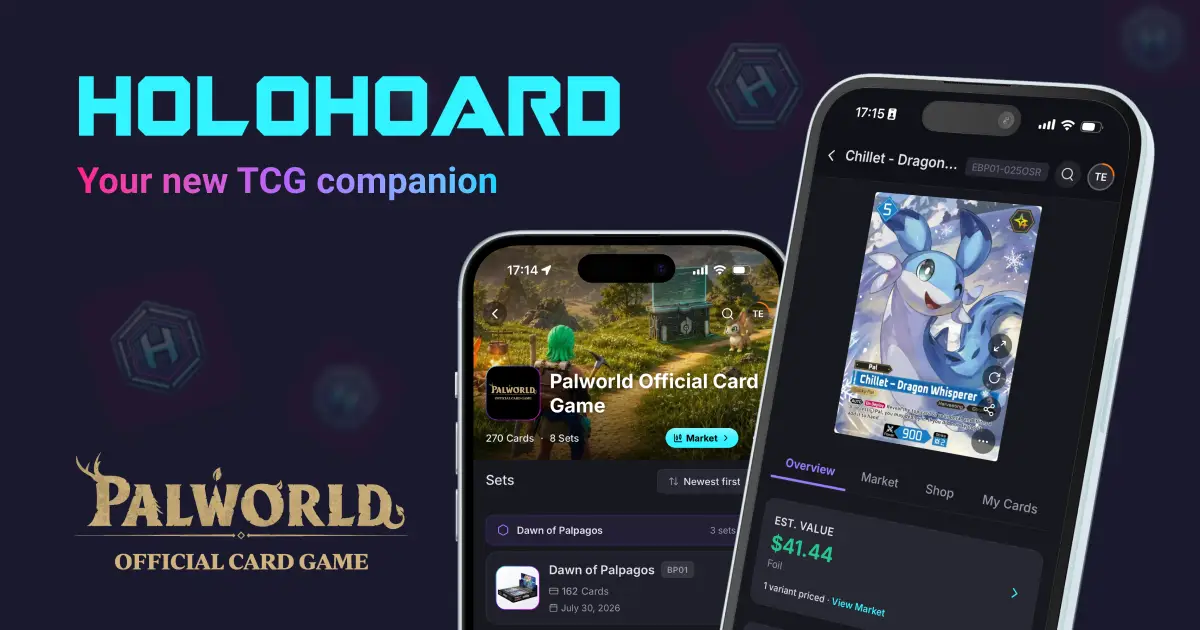
That is the kind of thing a Palworld TCG collection tracker has to get right on day one, because it cannot be fixed later. HoloHoard has the entire Palworld Official Card Game catalogue built — every set, every parallel, every Pal’s element and work suitability, with daily market values on the cards that are trading. It runs in your browser and in the HoloHoard app on your phone, on one account.
Track your Palworld Official Card Game collection on HoloHoard →
The one thing to learn before you start ticking boxes
A Palworld booster set has a base run on plain card numbers: Common, Uncommon, Rare and Double Rare. Most of those cards then appear again as a parallel, with completely different art and its own suffixed number.
So EBP01-001, EBP01-001OSR and EBP01-001SSP are three separate entries on the checklist, not one card in three finishes.
The suffix tells you exactly where a card sits:
| Marking | What it is |
|---|---|
| No suffix | The base card: Common, Uncommon, Rare or Double Rare |
| SR | Super Rare, a parallel of a base card with new art |
| OSR | Over Super Rare, a step above Super Rare |
| SP | Super Parallel, the alternate art chases |
| SSP | Super Special Parallel, the top of the parallel run |
| TD, TSR, TSP | Trial deck cards, on a ladder of their own including its own parallel |
| SSS | Super Special Soul, a resource card that is a chase in its own right |
| PR | Promo, from events and campaigns |
Two things fall out of that, and both matter for tracking:
Super Rare and Over Super Rare are parallels, not rungs above Double Rare. That reads backwards if you know Bushiroad’s other lines, but the publisher’s own count proves it: Common, Uncommon, Rare and Double Rare add up to exactly 100, and SR, OSR, SP and SSP add up to exactly 61.
Trial decks run a second ladder entirely. A card marked TSR came from a deck and never from a pack. A tracker that flattens both ladders into one will tell you a set is complete when it is not.
HoloHoard lists every one of them as its own card, so set completion tells you the truth.
What is actually in the tracker
Around 270 Palworld cards are catalogued as of September 2026, across eight sets grouped into release waves:
- Dawn of Palpagos (BP01) — the first and largest booster, 162 cards including 16 parallels
- Dawn of Palpagos Red & Blue (TD01) and Green & Purple (TD02) — the launch trial decks, each with its own deck-only cards and its own parallels
- Promo Cards — event and campaign cards on the
EPR-run - Prototype Cards — the fifteen not-for-sale demo Pals from Bushiroad’s own Basics of the Game materials, with no printed number at all. Most databases drop these. We catalogued them, because they exist and people own them
- Legends Awaken (BP02) and the two Eternal Ascent trial decks are in place and waiting on their card lists
Soul cards sit on their own ESOUL- run rather than inside any one set, which is genuinely how they are numbered — one turns up in TD01, seven more in the promo set, and one of them carries the Super Special Soul rarity.
The details you can actually filter on
This is where the Palworld catalogue is deeper than most. Every card carries what is printed on it:
- Colour — Red, Blue, Green, Purple, and Colorless cards that fit anywhere
- Element — Dark, Dragon, Electric, Fire, Grass, Ground, Ice, Neutral, Water, and real dual types: Dragon/Fire, Ground/Water and 22 other combinations
- Work suitability — Collecting, Cooling, Crafting, Electricity, Farming, Harvesting, Kindling, Transporting, with up to four on a single Pal
- Pal subtype — Normal Pal or Lucky Pal
- Cost, Power, Strike and, on Structures, Durability
If you collect by element, or you want every Kindling Pal in Red under 3 cost, that is a filter rather than an afternoon of scrolling.
One small detail we keep because collectors notice it: Structure cards are printed landscape. All 35 of them, and nothing else in the game. They are the only cards you turn the binder sideways for.
Card values, on a set that is fully priced
Palworld has full market intel on HoloHoard:
- The Palworld market hub ranks the most valuable cards in the game and breaks value down by set
- Card pages carry price history, so you can see how something has moved rather than just what it costs today
- Your collection total updates on its own, daily, along with every list and deck you have built
Dawn of Palpagos is the set most people are opening, and every card in it carries a value — all 162. We published the most expensive Dawn of Palpagos cards off the back of that, ranked from live data rather than typed up by hand.
The short version of what the ranking shows: the top of the set is almost entirely parallels, which is a consequence of how the set is printed rather than a coincidence.
Foil is not a second thing to chase. In plenty of games foil quietly doubles the checklist. Here the finish is attached to the rarity tier — lower tiers print non-foil, Rare and above print foil, and no card exists in both. So the value conversation is about rarity and parallels, and never about hunting the foil version of a card you already own.
Print the checklist, or take it as a spreadsheet
Every set has a checklist page built from the live catalogue: each card against every variant it comes in. Tick cards off as you go, print the lot to paper or PDF for the binder, or export it as XLS or CSV.
Open the Dawn of Palpagos checklist →
It is the fastest way to see what a complete Dawn of Palpagos looks like next to what is actually in your box.
On the web, and in your pocket
HoloHoard runs in any browser at holohoard.app, and the HoloHoard app is already on Google Play for Android.
Same account either way. Mark a pull on your phone at a prerelease and it is there on the web when you get home. Photograph the actual copy you pulled and it attaches to that card in your collection.
Cataloguing, lists and decks, condition, grading and serial numbers, per-card values, market basics and sharing are all free on both. Premium is optional and adds the power tools: deeper value analytics, full sales history, export, and unlimited collections, lists and uploads.
How to start tracking your Palworld collection
- Open the Palworld Official Card Game page on the web or in the app
- Pick your set. Packs go in Dawn of Palpagos; the launch decks have their own sets, because their cards are deck-only
- Mark what you own — and read the number, not just the art. A suffix after the number means you are holding a parallel, which is its own entry
- Build lists for what you are chasing: the SSP run, a colour, or every Pal with a work suitability you need
- Watch the total move with the market
What we do not do
HoloHoard decks are flexible, shareable lists, not a rules validator. We do not check whether your Main Deck and Soul Deck are legal for tournament play. What we do is keep decks connected to your collection: what you own, what you are missing, what it is worth, and a link you can send someone.
We also will not tell you what a card will be worth. Values here are tracked data points, not forecasts.
What is next for the line
Bushiroad launched the Palworld Official Card Game simultaneously worldwide on 30 July 2026, on the back of a video game with, by the publisher’s own count, more than 35 million players — an enormous audience that has mostly never bought a card from this line.
The release schedule from here:
- 2 October 2026 — Sleeve & Card Set Vol.1, with 75 sleeves and five exclusive card types
- 30 October 2026 — Legends Awaken, the second booster
- 18 December 2026 — the Eternal Ascent trial decks, Red/Green and Blue/Purple
Each one gets catalogued as its list lands, parallels and all.
FAQ
Is there a Palworld card game collection tracker?
Yes. HoloHoard tracks the Palworld Official Card Game on the web at holohoard.app and in the HoloHoard app. Get the app here.
Is it free?
Yes for everything most collectors need: cataloguing, lists and decks, condition, grading and serial numbers, per-card values, market basics and sharing. Premium is an optional upgrade.
What does SP or SSP mean on a Palworld card?
Super Parallel and Super Special Parallel. Both are parallels — separate cards with their own numbers and their own art, not alternate printings of the base card. They sit at the top of the booster run and at the top of the value table. Full breakdown in the Palworld collector’s guide.
Can I see what my Palworld cards are worth?
Yes. Values show as you browse, card pages carry price history, and your collection total updates daily. Dawn of Palpagos is fully priced — see the most expensive Dawn of Palpagos cards.
Are the Prototype demo cards tracked?
They are. Fifteen not-for-sale Pals with no printed card number, catalogued because collectors do end up holding them.
The Palworld Official Card Game is published by Bushiroad. Palworld and all related marks are the property of their respective owners.