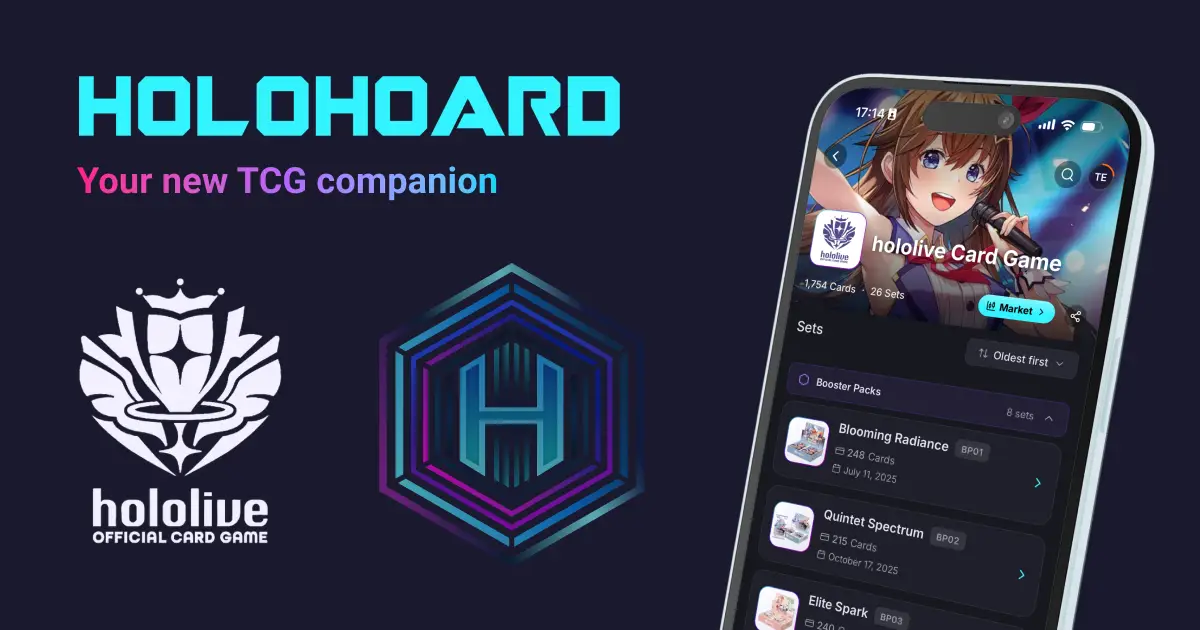
HoloHoard now has the whole English hololive line catalogued properly! Every parallel as its own entry, with daily market values across every released set. It runs in your browser and in the HoloHoard app on your phone, on one account.
Track your hololive card game collection on HoloHoard →
The rarity ladder is two ladders
This is the single easiest thing to get wrong about holoca, and it reads backwards if you know other card games.
The standard run of a booster is only five rarities: OSR, RR, R, U, C. Everything else — SEC, OUR, UR, HR, SR, S, SY — is a parallel of a card already in that standard run.
So Super Rare is not a rung above Double Rare. It is a parallel of a Common, or an Uncommon, or a Rare. The publisher’s own per-set breakdown says so out loud: Enchant Regalia is announced as “Standard, 108 types” and “Parallel, 124 types”, counted separately.
| Code | What it is | Half |
|---|---|---|
| OSR | Oshi holomem Super Rare | standard |
| RR | Double Rare | standard |
| R | Rare | standard |
| U | Uncommon | standard |
| C | Common | standard |
| OC | Oshi holomem Common | standard, Start Cheer Set only |
| SEC | Secret Rare | parallel |
| OUR | Oshi holomem Ultra Rare | parallel |
| UR | Ultra Rare | parallel |
| HR | holomem Rare, introduced in Enchant Regalia | parallel |
| SR | Super Rare | parallel |
| S | Special | parallel |
| SY | Special Cheer | parallel |
| P | Promo | the promo set |
A master set is the standard run plus its parallels, which is why a real checklist runs far longer than the announced “types” count. Of the 855 distinct card numbers in the line, most exist as more than one card.
On HoloHoard each of those is its own entry with its own value and its own place in your collection. Mark off the Common and its Secret Rare is still sitting there, open, where it belongs.
Reprints keep their original number too
Forty-seven card-and-rarity combinations appear in two or three different sets, because a later booster reprints an earlier card and the card keeps its original number.
We catalogue each printing as its own card, in the set that actually contains it, with its own price history. That means searching a reprinted card shows you two or three rows — which looks like clutter for about five seconds, until you realise the alternative is a later set’s checklist that can never be completed.
What is in the tracker
1,754 cards across 26 sets, organised the way the publisher organises them:
- Booster Packs — Blooming Radiance, Quintet Spectrum, Elite Spark, Curious Universe, Enchant Regalia and Ayakashi Vermilion, the biggest and newest set with cards in it
- Start Decks — every deck from Tokino Sora and AZKi through the colour decks to Oshi Advent and Oshi Justice, plus the Start Cheer Set
- Extra Boosters — Summer hologram, ready for its cards
- Promo Cards — 139 of them, including the Bloom Cup and Bloom Cup DX event exclusives
Every card carries what is printed on it: colour, Bloom Level, HP, Arts, Baton Pass, LIFE on Oshi holomem cards, Support sub-types, and the full ability text.
One detail we went out of our way on: the game has two card backs, one for holomem, Oshi and Support cards and a different one for the Cheer deck. All 1,754 cards render the right one. It is a small thing that looks wrong immediately if you get it wrong.
Collect by generation, not just by rarity
The best filter in this game is not a rarity. It is the Tags line printed on every holomem card, which says exactly which branch and generation the talent belongs to.
#Gen 0 through #Gen 5, #GAMERS, #holoX, #Myth, #Promise, #Advent, #Justice, #ReGLOSS, #DEV_IS, #ID Gen 1 to #ID Gen 3, and the branch tags #JP, #EN, #ID. Alongside them sit character traits: #Singing, #Cooking, #Kemomimi, #Bird and a dozen more.
They are rules text and fandom taxonomy at the same time — card effects reference them directly — which makes “every card of my oshi’s generation” a completely legitimate collecting goal with a filter behind it.
Colour works the same way, and it is worth knowing the line has been adding them: purple arrived in Quintet Spectrum, and yellow made its first appearance in Elite Spark.
What your cards are worth
hololive has full market intel on HoloHoard. Every released set is priced, from 278 of 280 cards on Ayakashi Vermilion down to 118 of 139 on the promo set. The announced sets that have not shipped cards yet sit at zero and fill in on their own.
- The hololive market hub ranks the most valuable cards in the game and breaks value down by set
- Card pages carry price history, so you can see how something moved rather than just today’s number
- Your collection total updates daily, along with every list and deck you have built
The shape of the top end, as of late September 2026: it is Secret Rares, all the way down. Every card in the top ten is a SEC, led by a Hakos Baelz from Ayakashi Vermilion sitting north of two thousand dollars, with Hoshimachi Suisei from Blooming Radiance and Mikkorone 24 from Quintet Spectrum behind it. That is not a coincidence — it is the parallel structure showing up in the prices.
The promo set behaves unlike any of the boosters, which is worth a look on its own if you chase event cards.
Print the checklist, or take it as a spreadsheet
Every set has a checklist page built from the live catalogue: each card against every variant it comes in. Tick cards off, print the lot to paper or PDF for the binder, or export it as XLS or CSV.
Open the Ayakashi Vermilion checklist →
On the web, and in your pocket
HoloHoard runs in any browser at holohoard.app, and the HoloHoard app is on Google Play for Android.
Same account either way. Mark a pull on your phone at a local event and it is on the web when you get home. Photograph the actual copy you pulled, slab included, and it attaches to that card in your collection.
Cataloguing, lists and decks, condition, grading and serial numbers, per-card values, market basics and sharing are all free on both. Premium is optional and adds the power tools: deeper value analytics, full sales history, export, and unlimited collections, lists and uploads.
How to start tracking your hololive collection
- Open the hololive card game page on the web or in the app
- Pick the set you are opening. Ayakashi Vermilion is the current booster; the Start Decks each have their own set because their cards are deck-only
- Mark what you own, and read the rarity, not just the number. Two cards sharing a number is normal here, and the rarity is what tells them apart
- Build lists for what you are chasing: your oshi’s generation, a colour, the SEC run
- Watch the total move with the market
What we do not do
HoloHoard decks are flexible, shareable lists, not a rules validator. We will not check your 50-card main deck and 20-card cheer deck against tournament rules. What we do is keep decks connected to your collection: what you own, what you are missing, what it is worth, and a link you can send someone.
We also will not tell you what a card will be worth. Values here are tracked data points, not forecasts.
What is next for the line
The English edition launched on 11 July 2025 and the release schedule has not let up since:
- 25 September 2026 — Extra Booster: Summer hologram
- 23 October 2026 — six Live Start Decks: Shirakami Fubuki, Juufuutei Raden, Sakura Miko, Hoshimachi Suisei, Mori Calliope and Oozora Subaru
- 20 November 2026 — Diva Fever, Booster Pack 07
- 29 January 2027 — Bouncer Bound, Booster Pack 08
All eight sets are already in the tracker, waiting for their card lists. Cards land as the lists do.
FAQ
Is there a hololive card game collection tracker?
Yes. HoloHoard tracks the hololive OFFICIAL CARD GAME on the web at holohoard.app and in the native HoloHoard app. Same account and same collection in both. Get the app here.
Is it free?
Yes for everything most collectors need: cataloguing, lists and decks, condition, grading and serial numbers, per-card values, market basics and sharing. Premium is an optional upgrade.
Why do two hololive cards have the same number?
Because that is how the game prints parallels. A parallel shares its base card’s number and differs by rarity and art. They are separate cards, they are worth very different amounts, and HoloHoard lists them separately so your set completion is honest.
Is a Super Rare better than a Double Rare?
They are not on the same ladder. Double Rare is the top of the standard run; Super Rare is a parallel of a standard card. The publisher counts the two halves separately, and so do we.
What are the most expensive hololive cards?
Secret Rares, by a distance — as of September 2026 the entire top ten is SEC cards. The hololive market hub ranks them live.
Can I collect by generation?
Yes. Every holomem card carries its Tags, which name the branch and generation — #Gen 0 to #Gen 5, #Myth, #Promise, #Advent, #Justice, #ReGLOSS, #DEV_IS, the ID generations and the #JP / #EN / #ID branch tags. Filter on them and build a list.
hololive OFFICIAL CARD GAME is published by Cover Corp. hololive and all related marks are the property of their respective owners.